

Skin Barrier Repair Cream: A Clinical Guide to Calmer, More Resilient Skin
A skin barrier repair cream can support calmer skin, but it isn’t a one-step rescue. Dryness, tightness or sensitivity can feel like signs of a weakened barrier, yet these symptoms can have other causes too. A cream may help maintain hydration and reduce moisture loss, but choosing one thoughtfully matters, particularly when skin is already uncomfortable.
Conflicting ingredient claims can make that choice feel less straightforward. Ceramides, niacinamide and other familiar ingredients may have a role in moisturising formulations, but no single ingredient suits everyone, and individual tolerance varies. A new product can also feel uncomfortable, so introduce it gradually and pay attention to how your skin responds.
This guide explains what the skin barrier does and how a skin barrier repair cream can support everyday care. You’ll learn what to look for in a formula, how to introduce a cream without changing your whole routine and why consistency matters more than expecting an immediate transformation. We’ll also cover when persistent or worsening symptoms warrant advice from a healthcare professional.
Key Takeaways
- Learn how the skin barrier helps limit water loss, and why dryness or tightness alone cannot identify its cause.
- Understand how humectants, emollients and occlusives serve different purposes in a moisturiser.
- Use texture, how your skin feels and your existing routine to guide your choice of skin barrier repair cream.
- Introduce a cream thoughtfully, follow its product directions and stop using it if discomfort develops.
- Explore barrier-focused skincare from Nordelle Essence, a doctor-led Nordic skincare brand founded by medical doctor Dr Aiste Linkeviciute-Konenko.
What Is the Skin Barrier, and What Does a Repair Cream Support?
Dryness, tightness or sensitivity can be uncomfortable and may leave you wondering whether your skin needs extra support. These sensations can have several causes, however, and they don’t confirm that the skin barrier is damaged or identify a medical condition.
A skin barrier repair cream is a moisturiser designed to support the skin’s comfort and moisture retention; it doesn’t instantly rebuild the barrier or treat an underlying medical condition. Its role is supportive: it can help reduce moisture loss while the skin’s natural processes continue. The effect depends on the complete formula and how your skin tolerates it.
How the stratum corneum helps protect skin
The barrier’s outermost layer, the stratum corneum, is often explained through a bricks-and-mortar analogy. Flattened skin cells act like the bricks, while lipids, including ceramides, cholesterol and fatty acids, form part of the mortar between them. Together, this organised structure helps shield the body from external irritants and limit water escaping from the skin. For further reading, see this scientific review of skin-barrier function and moisturization.
This outward movement of water is called transepidermal water loss. Some water loss is a normal part of skin function. If the barrier is less effective, moisture may escape more readily, which can contribute to dryness or tightness. A moisturising cream can support the skin’s surface by supplying moisture and helping reduce its loss, but the barrier is not something a cream can reconstruct in a moment.
What can make skin feel dry or reactive
Cold air, wind or low humidity can leave skin feeling less comfortable. Cleansing with products that are too harsh for your skin, or exfoliating too often, may also contribute to dryness and sensitivity. These are possible influences, not proof of barrier damage. Skin can react for different reasons, and a cream cannot establish the cause.
Notice patterns rather than drawing conclusions from one symptom. For example, consider whether discomfort began after a change in weather, a new product or more frequent exfoliation. If symptoms persist, worsen or become painful, seek advice from a healthcare professional. Ongoing redness and irritation may also merit assessment, particularly if they interfere with everyday comfort.
Support, not instant repair
A cream may ease the sensation of dryness by helping skin stay hydrated and feel more comfortable. That supportive role is distinct from diagnosing or treating conditions such as eczema or contact dermatitis, which may need professional assessment and condition-specific care. The word “repair” on a label is not a promise of immediate restoration.
Assess a product by its purpose, directions and how your skin responds over time. If discomfort increases after application, stop using it. Seek appropriate advice if the reaction is persistent or concerning. Barrier care is best understood as measured support, not a guaranteed solution to every cause of sensitivity.
How Skin Barrier Repair Creams Support Hydration and Comfort
Moisturising creams can support the skin in several related ways, but adding or binding water, softening the skin and reducing moisture loss are distinct functions. A formula may combine them. The balance of ingredients and texture of the finished product influence how it feels on the skin.
Moisturising products can help skin feel more comfortable by adding or binding water, softening rough areas and helping to limit moisture loss from the surface. This is supportive skincare, not a cure for eczema, psoriasis, dermatitis or another medical condition. Persistent or troublesome symptoms need appropriate professional advice.
Humectants, emollients and occlusives have different roles
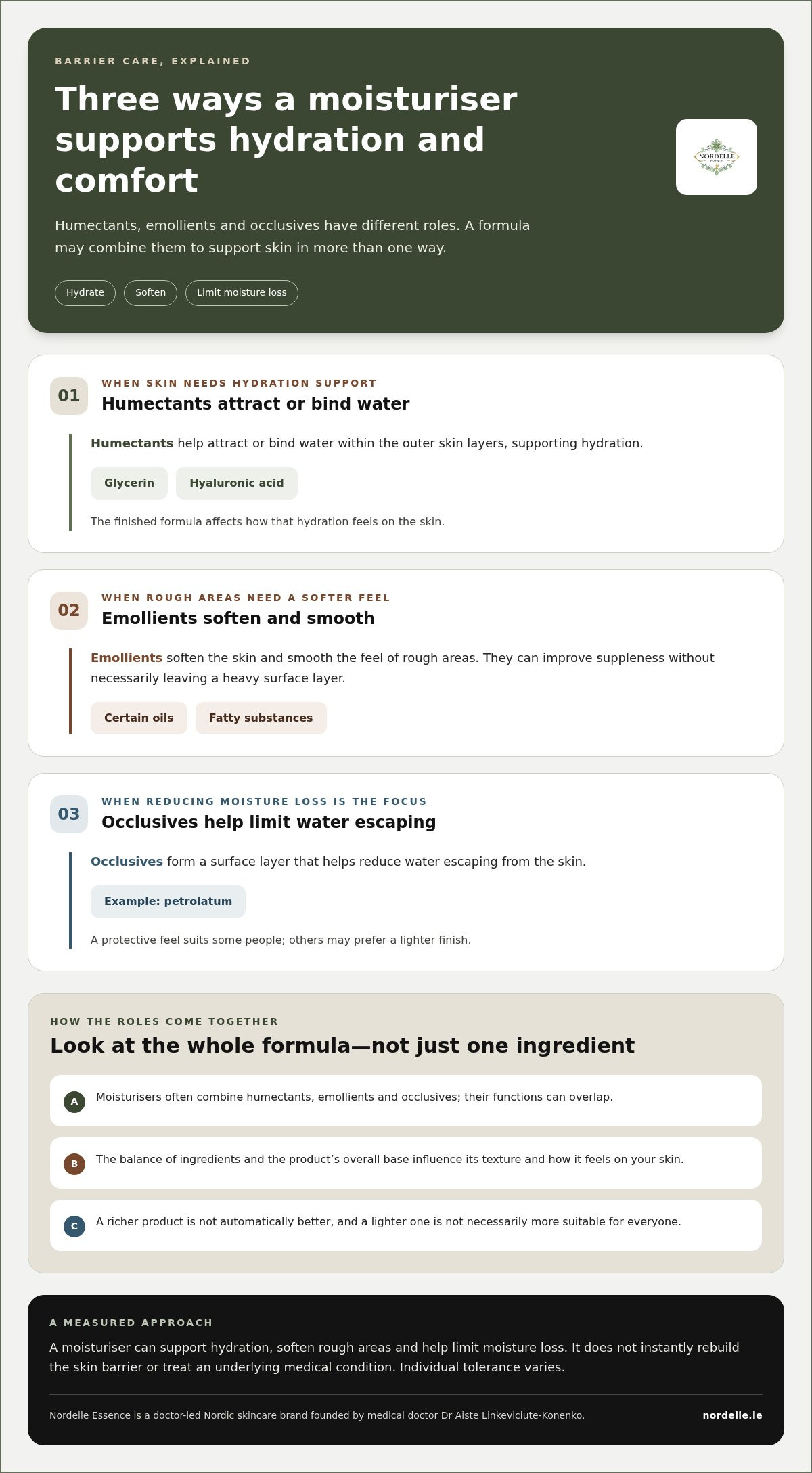
Look beyond a headline ingredient and consider what the formula is designed to do. Humectants, emollients and occlusives can contribute in different ways:
- Humectants, such as glycerin or hyaluronic acid, attract or bind water within the outer skin layers. They support hydration, although the finished formula affects how that hydration feels.
- Emollients, including certain oils and fatty substances, soften the skin and smooth the feel of rough areas. They can improve suppleness without necessarily creating a heavy surface layer.
- Occlusives, such as petrolatum, form a surface layer that helps reduce water escaping from the skin. This can feel protective to some people, while others may prefer a lighter finish.
These functions can overlap, and products often combine ingredients to address more than one. A cream with humectants may feel different depending on its emollients and occlusives, as well as its overall base. Consider your preferred texture and how the product feels on your skin. A richer product is not automatically better, and a lighter one is not necessarily more suitable for everyone.
Ceramides and the skin’s lipid structure
Ceramides are lipids found naturally within the skin barrier, where they form part of the structure that helps keep the outer layers cohesive. Their use in skincare has a clear formulation rationale: a product containing ceramides includes components relevant to the barrier’s lipid structure. That rationale alone doesn’t establish how a particular cream will perform for every person.
Read ingredient lists in context. The complete formulation, including the balance of ingredients and the product’s texture, shapes how it feels and is used. A single featured ingredient cannot tell you whether the cream will suit your skin. Individual tolerance varies, too. If a new product causes persistent discomfort, stop using it and seek professional advice where needed.
For a barrier-focused option, explore the Ceramide Barrier Night Cream from Nordelle Essence, a doctor-led Nordic skincare brand founded by medical doctor Dr Aiste Linkeviciute-Konenko. The product name offers context, but your choice should still reflect your preferences and how your skin responds to the formula.
Choosing a Skin Barrier Repair Cream: Ingredients, Texture and Tolerance
Choosing a skin barrier repair cream is less about finding one ideal ingredient and more about identifying a formula that fits how your skin feels, your texture preferences and the rest of your routine. Ingredient names can offer clues about a product’s intended role, but they don’t establish whether it will suit you or predict your individual response.
Formulation, use and personal tolerance all shape product experience. Start by comparing what different moisturising ingredients are generally used for, then consider how the whole product feels in practice.
| Ingredient group | General function | Consider |
|---|---|---|
| Humectants | Attract or bind water in the outer skin layers. | Useful in formulas designed to support hydration. |
| Emollients | Soften skin and improve the feel of rough areas. | Their combination affects smoothness and richness. |
| Occlusives | Help reduce moisture loss by forming a surface layer. | Some people prefer their protective feel; others favour a lighter finish. |
Match cream texture to how your skin feels
Texture is a practical preference, not a diagnosis. A lighter-feeling lotion may sit comfortably beneath other products, whilst a richer cream may feel more cushioning. Either can be a reasonable choice. Consider whether the finish feels comfortable, whether the product absorbs as you prefer and how it layers with sunscreen or make-up. Labels such as “dry”, “oily” or “sensitive” don’t dictate one correct texture.
Read ingredient lists with realistic expectations
The full formula matters more than a celebrated ingredient in isolation. Ceramides are one option in barrier-focused formulations, and niacinamide is used in some skincare products, but neither is a universal requirement. Concentration, supporting ingredients and the product’s overall design all influence its character. An ingredient’s presence alone doesn’t confirm that a product will feel comfortable or perform as you hope.
Consider your existing routine, too. If it already includes exfoliating ingredients, adding another product with exfoliating properties may not suit a routine that currently feels reactive. This doesn’t mean those ingredients are unsuitable for everyone. It is a reason to assess the whole routine rather than treating each product as a separate choice.
Before choosing, consider three practical points:
- Current feel: Is your priority a more hydrated feel, softness or a less tight sensation?
- Preferred finish: Do you favour a light layer, or a richer texture that remains more noticeable on the skin?
- Routine fit: Will the cream layer comfortably with the products you already use, without adding unnecessary steps?
Introduce one new product at a time, follow its directions and observe how your skin responds. Individual tolerance varies, so make your decision using both the ingredient list and your own experience, rather than relying on a promise on the label.
How to Introduce a Barrier Cream Without Overcomplicating Your Routine
A new cream is easier to assess when the rest of your routine stays familiar. If you introduce several products together, it can be difficult to tell which one is associated with a change in comfort or appearance. Keep the process simple and measured.
Use this four-step approach to introduce a skin barrier repair cream thoughtfully:
- Simplify: Stick with products you already know and tolerate, and avoid adding several new items at once. If your routine includes optional exfoliating products, consider keeping it steady rather than increasing their use during this period.
- Introduce: Apply the cream to clean skin, following the directions for that specific product. Don’t assume that every cream is intended for the same time of day or frequency of use.
- Observe: Pay attention to how your skin feels after application and as you continue using the product. Notice comfort, visible changes and whether the cream sits well with the other products in your routine.
- Adjust: If the product feels uncomfortable or you notice a concerning reaction, discontinue use. Individual tolerance varies, and a product that suits one person may not suit another.
A measured approach to adding a new cream
Give the new product a clear place in a simple routine, rather than changing your cleanser, exfoliant and moisturiser at the same time. This makes it easier to identify what may be affecting your skin. Observe how things develop without expecting a specific result by a set date; the experience depends on the product and the individual. For guidance on a gentle evening routine, see this night-time routine for dry, sensitive skin.
Follow the product’s own directions, including any advice about amount or frequency. If the directions are unclear, don’t compensate by applying it more often. A steady routine can be more informative than frequent changes, particularly when you’re trying to understand your skin’s response.
When skincare alone may not be enough
Occasional dryness may settle with a simpler routine and suitable moisturising care. Persistent, severe or worsening symptoms call for a different level of attention. Pain, swelling, extensive irritation or concerns that don’t resolve are reasons to seek advice from a qualified healthcare professional. A cosmetic cream can support daily comfort, but it cannot replace clinical assessment or prescribed treatment.
If discomfort begins after introducing a product, stop using it and avoid adding further new products while you assess what to do next. Seek prompt medical advice if symptoms are significant or continue to worsen. This measured approach helps you avoid treating every change as a barrier problem, while leaving room for professional guidance when it’s needed.
For a considered approach to daily skincare, explore Nordelle Essence skincare.
A Doctor-Led Perspective on Skin Barrier Creams from Nordelle Essence
Barrier care is best approached as steady support, not instant repair. A moisturiser can form part of a considered routine, but its role depends on the full formula, how it is used and how an individual’s skin responds. A calm, consistent approach also makes it easier to notice whether a product feels comfortable and fits your everyday needs.
A skin-health-first approach to barrier support
Nordelle Essence is a doctor-led Nordic skincare brand founded by medical doctor Dr Aiste Linkeviciute-Konenko. Its skin-health-first approach focuses on supporting the skin barrier and hydration through considered care, rather than rapid promises or unnecessary complexity. Evidence-aware skincare means considering an ingredient’s rationale alongside the complete formulation and how the product is intended to be used.
Naturally derived ingredients may be part of a skincare formula, but “natural” does not automatically mean safer or more suitable. Ingredients of any origin can be poorly tolerated by some individuals, and the overall formulation matters. This distinction is particularly relevant when skin feels reactive. Individual tolerance varies, so no ingredient category or product can be assumed to suit everyone.
Using a moisturiser consistently and according to its directions gives it a more realistic role in your routine than expecting a single application to transform your skin. If a cream causes a concerning reaction, discontinue use. Ongoing or worsening symptoms deserve professional advice rather than repeated product experimentation.
Considering a ceramide night cream
A night cream can be one part of a broader moisturising routine, rather than a replacement for every other step or for professional care. The Ceramide Barrier Night Cream is one option from Nordelle Essence. Its name identifies the product, but the name alone cannot establish whether its texture, full formulation or use will suit a particular person. Follow the product directions and consider how it fits alongside the rest of your routine.
Let your experience guide whether you continue using a product. If it feels comfortable and fits your routine, consistency may be more useful than switching frequently in pursuit of an immediate result. If it does not feel right, stop and reassess; there is no need to persist simply because a cream is described as barrier-focused.
For a measured approach to skincare, you can explore Nordelle Essence skincare at your own pace. A product may support daily moisturising, while persistent, painful or worsening concerns remain a reason to seek qualified medical advice.
Choose a Considered Next Step
Your next step needn’t be a complete change to your skincare routine. Choose one manageable adjustment, give yourself space to assess how it feels and resist the pressure to pursue every new ingredient or claim. A skin barrier repair cream is a personal choice, and a thoughtful routine should feel practical as well as comfortable.
As your needs change, you can revisit that choice without treating every change in skin feel as a problem to solve immediately. If you’re considering a product, take time to understand its intended role and directions, then decide whether it fits the care you want to maintain. If symptoms remain concerning, skincare choices should sit alongside appropriate professional guidance.
Explore Nordelle Essence skincare for a considered, skin-health-first approach to barrier support and hydration.
Frequently Asked Questions
What does a skin barrier repair cream do?
A skin barrier repair cream can support hydration and help relieve the feel of tight or rough skin. Its cosmetic role is to moisturise, not to diagnose or treat a medical condition. It may fit into a routine after cleansing, but the amount and frequency should follow the product directions. If discomfort continues despite simplifying your routine, consider whether another cause needs professional assessment.
How long does it take for a skin barrier cream to work?
There’s no reliable timeline that applies to every person or product. Some people may notice a more comfortable feel soon after moisturising, while visible changes can vary with the formula, regular use and the reason for the symptoms. Don’t increase the amount or frequency to speed up results. If your skin is getting worse or remains uncomfortable, seek advice rather than waiting for a cream to resolve it.
Can a skin barrier repair cream cause breakouts?
Yes, a moisturiser can coincide with breakouts in some people, although a blemish doesn’t prove that the cream caused it. A richer texture may feel less comfortable on skin that prefers lighter products, and other routine changes can also be relevant. If spots appear after introducing a cream, pause it and avoid adding other new products while you observe whether your skin settles. Seek advice for persistent or severe breakouts.
Is a skin barrier cream suitable for sensitive skin?
Not necessarily. Sensitive-feeling skin can respond differently to the same product, so no cream can be assumed suitable for everyone. Check the full ingredient list for substances you already know you don’t tolerate, and follow the product’s guidance for trying it on a small area first. Stop use if you develop a concerning reaction. Persistent redness, swelling or pain warrants advice from a healthcare professional.
Can I use a barrier cream with active skincare ingredients?
Often, a moisturiser can sit alongside active skincare, but the combination depends on the products and your tolerance. If your routine includes an exfoliating acid or retinoid, avoid adding several new products at once so you can better identify what affects your skin. Follow each product’s directions, and don’t discontinue prescribed treatment without speaking to the clinician who recommended it. Reduce use and seek advice if irritation develops.
Should I use a skin barrier repair cream every day?
Daily use may be appropriate if the product directions allow it and your skin tolerates the cream, but it isn’t a requirement for everyone. Consider how your skin feels and whether the product fits comfortably into your routine. Use the amount and frequency stated on its label rather than applying extra in response to dryness. If you notice ongoing discomfort or a reaction, stop and reassess with professional guidance where needed.