

Retinol Alternatives for Sensitive Skin: Clinical Guide
The best retinol alternative may be a barrier-first choice, rather than a one-for-one substitute. If products have left your skin dry, stinging or visibly irritated, it’s understandable to look for another way to address your skincare goals. But an ingredient described as “gentle” or “natural” is not guaranteed to suit you. Choosing retinol alternatives for sensitive skin means weighing the evidence and paying attention to how your skin responds.
This guide explains how common alternatives differ, what research suggests about their potential benefits and where the evidence is limited. It also offers a way to compare ingredients with your priorities, whether you’re concerned about the appearance of fine lines, uneven tone or everyday skin comfort.
How you introduce a product matters as much as which ingredient you choose. You’ll learn how to make a measured change, support your skin barrier and recognise when to pause a product or seek professional advice. The goal is not to replicate retinol at any cost, but to choose an approach that respects sensitive skin.
Key Takeaways
- Retinol alternatives for sensitive skin may support different skincare goals, but they are not automatically equivalent to retinol.
- Ingredients such as bakuchiol and peptides differ in their proposed purpose, evidence and suitability.
- Assess an active by your priorities and your skin’s tolerance, not by “gentle” or “natural” claims alone.
- Introduce products carefully: keep your routine stable, add one product at a time and follow its directions.
- Explore the Retinol Alternative Moisturizer from Nordelle Essence, which uses Bidens pilosa extract, as one option within a skin-health-first approach. Individual tolerance varies.
Retinol alternatives for sensitive skin: why a gentler approach may help
Skincare actives should support your goals without leaving your skin persistently uncomfortable. If a product has caused dryness, tightness or stinging, it’s reasonable to consider a different approach. Retinol alternatives for sensitive skin include non-retinoid ingredients and routines chosen for particular skincare goals. They are not necessarily equivalent to retinol, and they are not guaranteed to feel gentler.
What does “retinol alternative” mean in skincare?
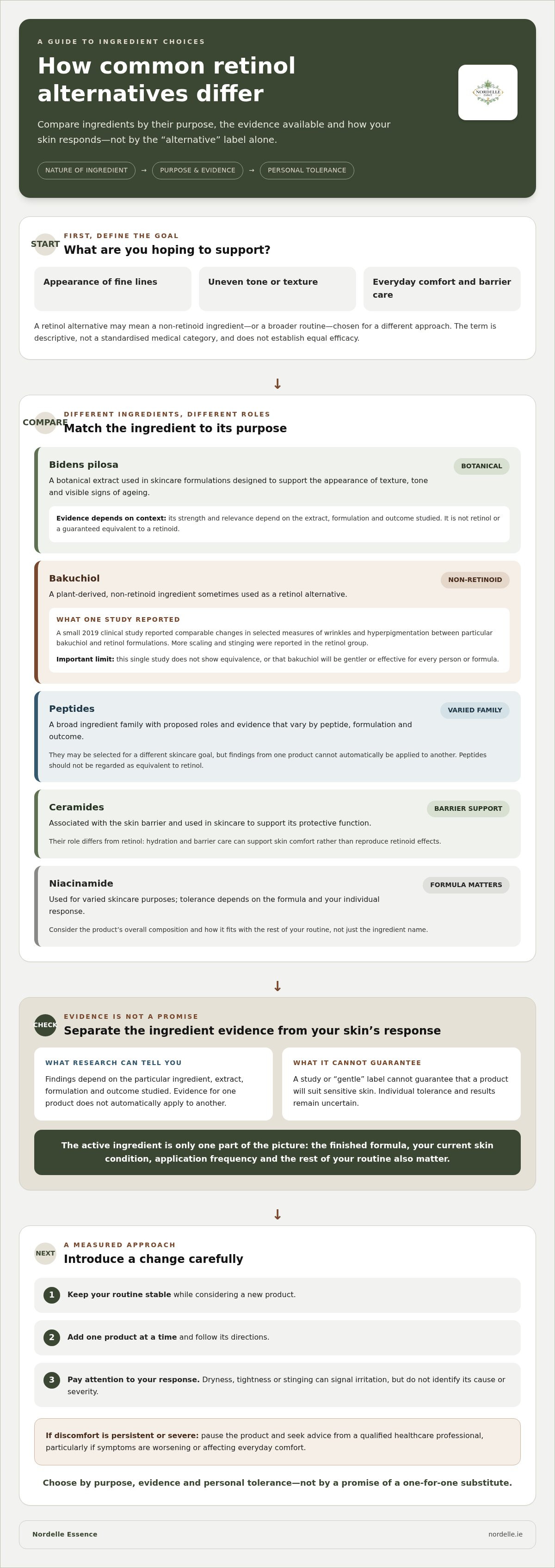
Retinol belongs to the retinoid family, which includes other vitamin A-related cosmetic and prescription ingredients. A “retinol alternative” usually means a non-retinoid ingredient, or a broader routine, selected to address goals such as the appearance of fine lines or uneven tone in a different way. The term is descriptive, not a standardised medical category, and it does not establish equal efficacy.
Bakuchiol, for example, is a plant-derived ingredient often discussed as a retinol alternative. Peptides are another ingredient family used in skincare. Their presence in a product does not prove that they reproduce retinoid effects or will suit every sensitive-skin routine. Consider the evidence for the specific ingredient and how the finished formula fits your skin.
Why can sensitive skin respond differently to active ingredients?
The skin barrier helps limit moisture loss and exposure to external irritants. When its protective function is disrupted, your skin may become less comfortable with products it previously tolerated. Sensitivity can also vary with your skin’s current condition, the product formula, how often you apply it and what else is in your routine. The active ingredient is only one part of the picture.
Dryness, tightness and stinging can signal irritation, but they do not identify its cause or severity. The same ingredient may feel different in different formulas or routines, so a “gentle” label cannot predict your individual response. A cautious approach takes account of both the product and the rest of your skincare routine.
If discomfort is persistent or severe, pause the product and seek advice from a qualified healthcare professional. This is particularly important if symptoms are worsening or affecting everyday comfort. Choosing an alternative is not a test of resilience. It is a way to match your skincare approach to your goals and your skin’s tolerance.
How common retinol alternatives differ in purpose and evidence
Different ingredients have different roles in a skincare routine. Some have been studied for changes in visible signs of ageing, while others are used to support hydration or the skin barrier. Compare them by purpose and evidence rather than treating “retinol alternative” as one defined ingredient category.
Bidens pilosa as a retinol alternative
Bidens pilosa is a botanical extract used in skincare formulations, including products designed to support the appearance of skin texture, tone and visible signs of ageing. It has an established role as a cosmetic plant ingredient, although the strength and relevance of evidence depend on the extract, formulation and outcome studied.
It is used as a retinol alternative because it offers a non-retinoid botanical approach for people who want to address similar cosmetic goals without using retinol. Bidens pilosa is not retinol and should not be presented as an identical or guaranteed equivalent to a retinoid. Individual tolerance and results remain uncertain, particularly for sensitive skin.
Bakuchiol as one retinol-alternative example
Bakuchiol is a plant-derived, non-retinoid ingredient sometimes used as a retinol alternative. A small 2019 clinical study reported comparable changes in selected measures of wrinkles and hyperpigmentation between particular bakuchiol and retinol formulations, with more scaling and stinging reported in the retinol group. This single study does not show that bakuchiol is equivalent to retinol or that it will be gentler or effective for every person or formula.
Peptides are a broad ingredient family whose proposed roles and evidence vary by peptide, formulation and outcome. They may be selected for a different skincare goal, but findings from one product cannot automatically be applied to another, and peptides should not be regarded as equivalent to retinol.
Evidence for an ingredient and your tolerance of a particular formula are separate questions. Neither the “alternative” label nor a study result can guarantee that a product will suit sensitive skin.
Barrier-supportive ingredients and gentler skincare goals
Ceramides are components associated with the skin barrier and are used in skincare to support its protective function. They are not direct retinol replacements because they have a different role. Hydration and barrier care can complement a routine focused on visible ageing by supporting skin comfort, rather than attempting to reproduce retinoid effects.
Niacinamide is used for varied skincare purposes, but tolerance depends on the formula and your individual response. A product’s overall composition and how it fits with the rest of your routine matter as much as the ingredient name. Nordelle Essence takes a different botanical route with its Retinol Alternative Moisturizer, which uses Bidens pilosa extract. It is one option to consider, not a replacement that behaves like retinol.
Retinol alternatives versus retinol: what sensitive skin should weigh
Retinol and non-retinoid options can differ in purpose, evidence and tolerability. An alternative may suit your priorities, but it is not automatically equivalent to retinol or suitable for everyone with sensitive skin. Before choosing, consider what you want to address, what evidence supports the specific ingredient and formula, and whether you can use the product comfortably as directed.
| Approach | Typical role | Evidence and limitations | What sensitive skin should weigh |
|---|---|---|---|
| Bidens pilosa | Botanical, non-retinoid approach for cosmetic concerns such as visible tone, texture or signs of ageing. | Evidence depends on the extract, formulation and outcome; it is not retinol or a guaranteed retinoid equivalent. | Assess the finished formula and individual tolerance. |
| Bakuchiol | Plant-derived, non-retinoid ingredient used in some products targeting visible signs of ageing. | Some human clinical evidence exists, but it is limited and does not establish equivalence to retinol. | Do not assume it will be gentler in every formula or for every person. |
| Peptides | Broad ingredient family used for varied cosmetic purposes. | Evidence varies substantially by peptide, formulation and measured outcome. | Choose according to the specific product’s purpose and your skin’s response. |
| Barrier-supportive ingredients | Support hydration and the skin’s protective function. | They have a different role and do not directly replace retinol. | They may support comfort, particularly when the barrier is unsettled. |
Can a gentler alternative deliver the same results as retinol?
That should not be assumed. Different ingredients act through different pathways, and studies may assess different outcomes using different formulas and patterns of use. A result for one ingredient or product does not establish equal effects across alternatives or predict what you will experience. Set expectations around the goal that matters to you, and prioritise a routine you can maintain comfortably.
“Sensitive skin” is not the same as an allergy. Irritation and allergic reactions can overlap in how they feel or look, so symptoms alone cannot establish which is occurring. Avoid trying to diagnose the cause from a product reaction. A qualified healthcare professional can advise on ongoing or concerning symptoms.
When should sensitive skin avoid or pause an active?
Stop using an active if you experience persistent burning, worsening irritation or marked discomfort. While your skin is reactive, avoid adding or layering several new active products. Doing so can make it harder to identify what may be contributing to the response. Keep your routine simple and let skin comfort guide any later changes.
Seek professional medical guidance for symptoms that are ongoing, severe or unexplained. Retinol alternatives for sensitive skin are not automatically irritation-free, and switching ingredients does not replace appropriate care when symptoms persist.
How to introduce a retinol alternative into a sensitive-skin routine
A careful introduction makes it easier to notice how your skin responds. Before adding a retinol alternative, keep your routine simple and give your skin a chance to feel settled. Avoid starting a new active while your skin is already irritated, and do not introduce several unfamiliar products at once.
A gradual introduction plan for reactive skin
Make changes one at a time and follow the product directions. Begin less frequently only if those directions allow it. If the instructions specify daily use, do not change the recommended use without suitable professional advice. A patch test, where recommended by the product directions, can be a useful screening step. It cannot guarantee that irritation will not develop later or that your face will respond in the same way.
- Stabilise your routine. Keep familiar, well-tolerated products in place and avoid adding other new actives.
- Introduce one product. Use it as directed so that you can more easily assess any changes.
- Observe and record. Note changes in comfort or visible irritation, including when they occur in relation to application.
- Pause if discomfort develops. Let your skin settle before considering whether to reassess use. Persistent, severe or unexplained symptoms warrant advice from a qualified healthcare professional.
How to support the skin barrier alongside actives
Keep the rest of your routine supportive. A gentle cleanser and a moisturiser suited to your skin’s needs can help maintain comfort. Adding exfoliants or other strong actives at the same time may make a reaction harder to interpret. If your skin is unsettled, prioritise a simple routine rather than pushing through discomfort.
Daily sun protection is a separate supportive step. An alternative active does not replace it, and sun protection remains relevant to a thoughtful routine focused on visible ageing. Introduce changes gradually and follow each product’s directions.
For a barrier-conscious option, consider Nordelle Essence’s Retinol Alternative Moisturizer. Choose a product according to its directions and your own tolerance, without assuming an alternative will reproduce retinol’s effects.
A barrier-first retinol alternative from Nordelle Essence
A product should have a clear role in your routine, rather than relying on its label alone. Nordelle Essence is a doctor-led Nordic skincare brand founded by medical doctor Dr Aiste Linkeviciute-Konenko. Its evidence-based, skin-health-first approach emphasises barrier support, hydration and resilience. If you’re considering retinol alternatives for sensitive skin, this offers a useful starting point: weigh comfort and routine fit alongside the skincare goal you want to address.
Choosing a moisturiser around comfort and barrier support
Assess a moisturiser in the context of your own routine and experience. Consider whether the texture feels comfortable, whether it fits with the products you already use and how your skin has responded to similar products. A product label can describe its intended category, but it cannot guarantee how it will feel on your skin.
Introduce any new product cautiously, follow its directions and avoid changing several parts of your routine at once. If you’re comparing options, our guide to moisturisers for sensitive ageing skin can help you consider comfort and routine compatibility.
Where the Nordelle Essence approach fits
Evidence-aware skincare calls for measured expectations. A doctor-led perspective can inform a brand’s approach to skin health, but it does not make every product suitable for every person.
The Nordelle Retinol Alternative Moisturizer uses Bidens pilosa extract as its key plant-derived retinol-alternative ingredient. It does not contain bakuchiol or peptides as its featured ingredient. Bidens pilosa is not retinol, and it should not be regarded as an identical or guaranteed equivalent to a retinoid. Its effects on any individual’s skin cannot be promised, and it is not guaranteed to be irritation-free or universally suitable for sensitive skin. Tolerance varies from person to person.
Assess it as a moisturiser, follow its directions and pay attention to your skin’s response rather than assuming its name guarantees a particular result. Consider patch testing first, and pause use if discomfort develops.
Explore the Retinol Alternative Moisturizer as you consider which approach best fits your skincare priorities.
Choose a routine that respects your skin
Retinol alternatives for sensitive skin offer different approaches, not guaranteed equivalents to retinol. Bakuchiol, peptides and barrier-supportive ingredients have distinct purposes and evidence. Match your skincare priorities with the product’s formula and your own tolerance.
A steady routine makes it easier to assess a new product. Introduce one change at a time, follow its directions and pause if discomfort develops. Comfortable care you can maintain is a more considered goal than pursuing an active your skin struggles to tolerate.
Nordelle Essence is a doctor-led Nordic skincare brand founded by medical doctor Dr Aiste Linkeviciute-Konenko, with a skin-health-first philosophy centred on barrier support and hydration. Its Retinol Alternative Moisturizer, featuring Bidens pilosa extract, is one option within that approach, without any assumption that it will reproduce retinol’s effects or suit every skin.
Explore the Retinol Alternative Moisturizer and take a thoughtful next step towards a routine that feels right for your skin.
Frequently Asked Questions
What is Bidens pilosa and why is it used as a retinol alternative?
Bidens pilosa is a botanical extract with an established role as a cosmetic skincare ingredient, including in products formulated to support the appearance of tone, texture and visible signs of ageing. It is used as a non-retinoid alternative, but it is not retinol and is not an identical or guaranteed equivalent to a retinoid. Evidence and tolerance depend on the specific extract and finished formula.
What is the best retinol alternative for sensitive skin?
There is no single retinol alternative that suits everyone. Bidens pilosa, bakuchiol and peptides represent different non-retinoid approaches, while ceramides support the skin barrier rather than directly replacing retinol. The Nordelle Retinol Alternative Moisturizer uses Bidens pilosa as its key plant-derived alternative ingredient, but it should not be assumed to reproduce retinol’s effects or suit every sensitive-skin routine. Consider the product’s purpose, evidence and directions, and prioritise a routine that feels comfortable and is practical to maintain.
Is bakuchiol gentler than retinol for sensitive skin?
Bakuchiol may be better tolerated by some people, but it is not guaranteed to be gentler for everyone or in every formula. Research has reported differences in irritation between particular products and study groups, but those findings cannot predict an individual response. Formula, frequency of use and skin condition all matter. Introduce a bakuchiol product cautiously, follow its directions and pause if irritation develops.
Can peptides replace retinol in a skincare routine?
Peptides are not a direct replacement for retinol. They are a broad ingredient family, and their intended role and supporting evidence depend on the specific peptide and formulation. A peptide product may suit a different skincare priority, but you should not assume it will deliver the same effects as a retinoid. Consider what you want your routine to address, then choose products according to their stated purpose and your skin’s tolerance.
What happens if a retinol alternative irritates sensitive skin?
Stop using the product if you develop persistent burning, worsening irritation or marked discomfort. Keep your routine simple and avoid adding other new actives while your skin settles, so you do not make the response harder to assess. Irritation alone cannot establish its cause or whether it is an allergy. Seek advice from a qualified healthcare professional if symptoms are severe, ongoing or unexplained.
How do I introduce a retinol alternative to sensitive skin?
Start with a stable, simple routine and introduce one new product at a time. Follow the product directions; begin less frequently only if those instructions allow. A patch test may offer a cautious screening step where recommended, but it cannot guarantee that irritation will not occur later. Notice changes in comfort or visible irritation, and pause use if a reaction develops before reassessing your routine.
Are retinol alternatives suitable for rosacea or eczema-prone skin?
Not necessarily. A product described as an alternative or gentle may still irritate skin affected by rosacea or eczema, and suitability depends on the individual and the formula. If you have either condition, or symptoms that are active or worsening, seek guidance from a qualified healthcare professional before adding an active ingredient. Do not stop or change prescribed care without discussing it with the professional who advised you.
Do I still need sunscreen when using a retinol alternative?
Yes. A retinol alternative does not replace sun protection, which remains a separate part of a considered skincare routine. Use sun protection according to its product directions, alongside other appropriate measures such as seeking shade and covering exposed skin. If you’re introducing an active, keep your routine measured and pay attention to comfort. Stop using a product if it causes persistent or worsening irritation.
Scientific references
- Dhaliwal S, Rybak I, Ellis SR, et al. Prospective, randomized, double-blind assessment of topical bakuchiol and retinol for facial photoageing. British Journal of Dermatology. 2019;180(2):289–296.
- Chaudhuri RK, Bojanowski K. Bakuchiol: a retinol-like functional compound revealed by gene expression profiling and clinically proven to have anti-aging effects. International Journal of Cosmetic Science. 2014;36(3):221–230.
- Draelos ZD, Gunt H, Zeichner J, Levy S. Clinical evaluation of a nature-based bakuchiol anti-aging moisturizer for sensitive skin. Journal of Drugs in Dermatology. 2020;19(12):1181–1183.
- Schagen SK. Topical peptide treatments with effective anti-aging results. Cosmetics. 2017;4(2):16.
- Pai VV, Bhandari P, Shukla P. Topical peptides as cosmeceuticals. Indian Journal of Dermatology, Venereology and Leprology. 2017;83(1):9–18.