

Mature Skincare: A Gentle, Evidence-Led 2026 Checklist
A mature-skin routine doesn’t need more steps; it needs thoughtful, consistent choices. If you’re unsure which products are useful, or concerned that active ingredients could increase dryness or sensitivity, a skincare routine for mature skin can feel difficult to get right.
Those concerns are understandable. Skin can become drier or more reactive over time, and advice about exfoliation, ageing and sun protection can seem contradictory. Start with a few dependable steps, then adjust them to your skin’s needs rather than building a routine around every new ingredient.
This guide sets out a straightforward morning and evening order, from cleansing and moisturising to daily sun protection. It also explains how hydration and barrier support fit into mature skincare, what to consider when choosing ingredients, and how to introduce or adjust products gradually according to individual tolerance. The aim is a routine you can follow consistently, with room to take a gentler approach when your skin needs it.
Key Takeaways
- Mature skin describes changing needs, not a single skin type. Dryness, sensitivity, uneven tone and visible lines can vary from person to person.
- A practical skincare routine for mature skin centres on cleansing, moisturising and morning sun protection, with extra steps chosen for a clear purpose.
- Consider ingredients such as ceramides and niacinamide in the context of their intended role and your individual tolerance.
- Start with your current concerns and routine, then introduce one new product at a time so you can observe how your skin responds.
- Use a simple product checklist to weigh a formula’s purpose, comfort and ease of use before adding another step.
What changes in mature skin, and what should a routine support?
Mature skin describes changing needs, not a diagnosis or a single, uniform skin type. Over time, some people notice increased dryness, sensitivity, uneven tone or visible lines; others see few changes or find that different areas of the face behave differently. These characteristics are not a checklist everyone will develop, and not every line or variation in tone needs correcting.
Ageing can reflect a combination of intrinsic factors and external influences, including sun exposure. The skin aging overview describes these processes and their visible signs. Because changes can have varied causes, keep routine choices proportionate: skincare can support comfort and skin health, but it cannot stop natural ageing.
A concise skincare routine for mature skin is a set of consistent steps chosen to meet individual needs: gentle cleansing, moisturising and daily sun protection, with any additional product selected for a specific purpose and introduced according to tolerance. The aim is not to pursue a particular appearance, but to care for your skin without unnecessary complexity.
Mature skin is not one skin type
Age-related changes and skin type are different considerations. Oily, dry and combination skin describe patterns of oiliness and moisture; they don’t determine how skin will change over time. Dryness or sensitivity can accompany an oily or combination complexion, and the same person may notice different needs across the cheeks, forehead or eye area.
That distinction can make product choices more practical. A person with an oily T-zone and dry cheeks may prefer different textures across the face, whilst someone prone to sensitivity may first focus on familiar, comfortable products. Changes in tone and lines are also individual features, not automatic signs that treatment is needed. Let your priorities reflect your own comfort and preferences.
Start with skin comfort and resilience
The skin barrier is the outer layer that helps limit moisture loss and provides protection from the surrounding environment. When skin feels tight, rough or easily unsettled, a gentle approach that supports moisture and comfort may be more useful than adding several active products at once. A moisturiser can help reduce dryness, although its feel and suitability depend on the individual formulation and your skin’s response.
Let your concerns and tolerance guide your routine. If a product causes persistent discomfort, pause it rather than pressing on in the name of a more elaborate regimen. Introduce new products one at a time so you can better observe how your skin responds. Daily sun protection is also a practical foundation, including on ordinary days when exposure may be incidental.
Consistency matters more than an extensive product count. A measured routine can support hydration, barrier comfort and protection while leaving visible lines and other natural changes free from unnecessary judgement. If a skin change is new, persistent or worrying, skincare guidance alone may not be enough; seek advice from a qualified health professional.
How do morning and evening skincare steps support mature skin?
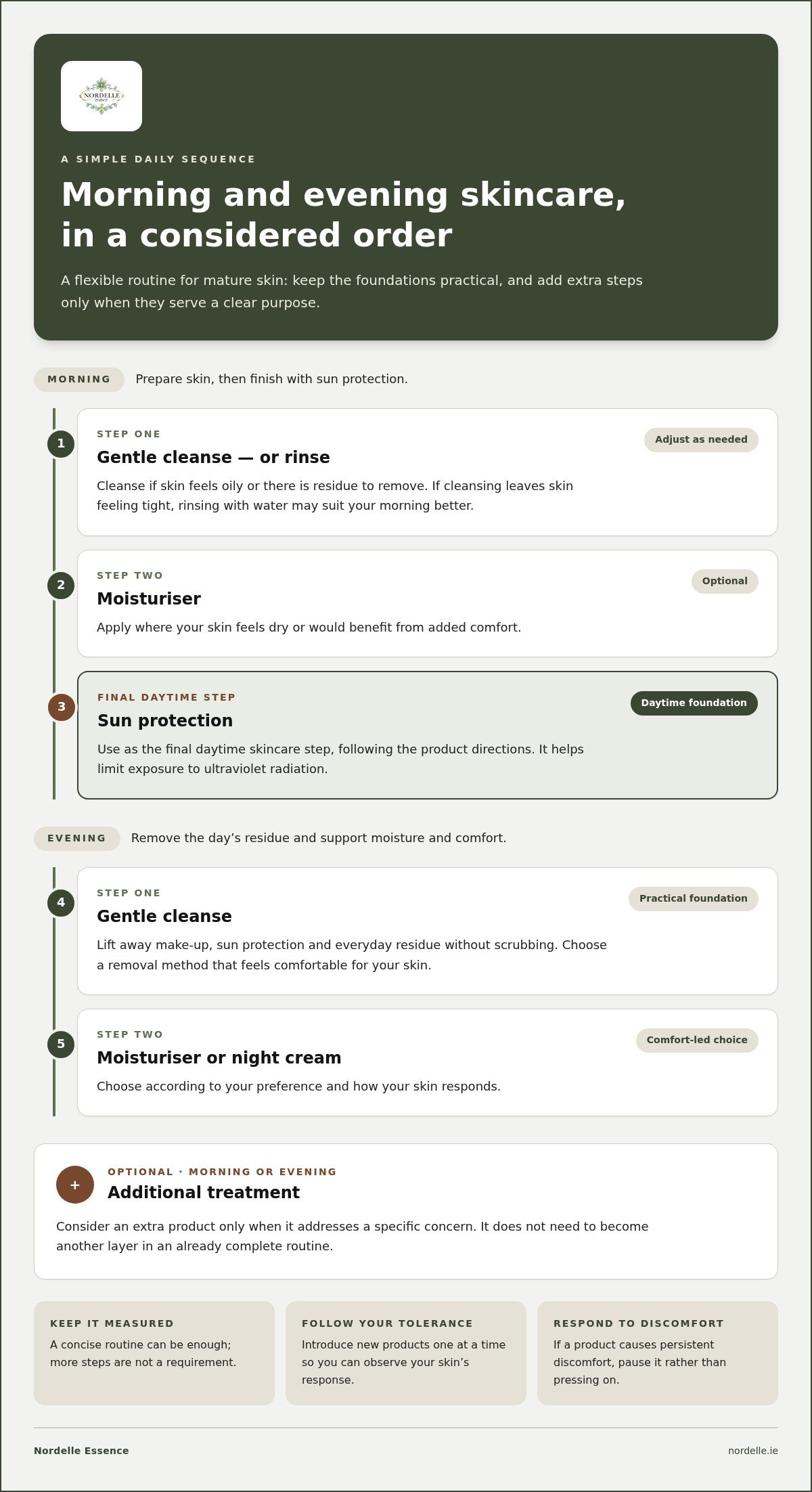
A clear order keeps daily care practical. In the morning, prepare the skin and finish with sun protection; in the evening, remove the day’s residue and apply moisture support. The National Institute on Aging’s guidance on changes in mature skin offers further context for adapting care as skin’s needs evolve. Use the outline below as a flexible starting point, not a requirement to use every product.
Time | Step | Purpose | Status
Morning | Gentle cleanse, or rinse if appropriate | Refresh skin without unnecessary cleansing | Adjust to skin and routine
Morning | Moisturiser | Add moisture where needed | Optional if another product provides enough comfort
Morning | Sun protection | Help protect exposed skin from UV radiation | Foundation of daytime care
Evening | Gentle cleanse | Remove daily residue, including make-up or sun protection | Practical foundation
Evening | Moisturiser or night cream | Support moisture and comfort | Choose according to preference and tolerance
Either | Additional treatment | Address a specific concern | Optional
A considered morning routine
Begin with gentle cleansing if your skin feels oily or there is residue to remove. If cleansing leaves your skin feeling tight, a lighter approach, such as rinsing with water, may suit your morning routine better. There is no need to cleanse more than your skin comfortably requires.
Apply moisturiser if your skin feels dry or would benefit from added comfort, then use sun protection as the final daytime skincare step, following the product directions. Consistent sun protection belongs in daytime skincare because it helps limit exposure to ultraviolet radiation, a contributor to skin ageing. It remains relevant beyond bright, warm days, as everyday outdoor exposure can still occur.
Optional treatments can be included if they serve a clear purpose and your skin tolerates them. They don’t need to become several layers, and a simple routine can be complete without them.
A restorative evening routine
In the evening, cleanse gently to lift away make-up, sun protection and everyday residue without scrubbing. If you wear make-up or find that one cleanse doesn’t remove it comfortably, choose a removal method that suits your skin and follow with a gentle cleanser if needed. Pat the skin dry rather than rubbing.
Apply a suitable moisturiser afterwards. A night cream, including a ceramide-focused formula, can be one way to add moisture and support a comfortable-feeling routine; it shouldn’t be understood as an overnight repair treatment. Individual tolerance varies, so the texture and formula matter as much as the time of day.
For a more detailed evening sequence, the article A Doctor’s Guide to Night-time Routine for Dry, Sensitive Skin explores night-time care further. A moisturiser or sun protection product from Nordelle Essence, a doctor-led Nordic skincare brand founded by medical doctor Dr Aiste Linkeviciute-Konenko, may suit your routine if its purpose and feel meet your needs.
Which skincare ingredients deserve a place in a mature-skin routine?
Choose ingredients by their purpose, then consider whether the finished product suits your skin and routine. A skincare routine for mature skin doesn’t require a particular list of actives. Moisturising formulations may help with dryness and comfort, barrier-supportive ingredients may suit a replenishing step, and daytime sun protection helps reduce ultraviolet exposure. The right balance depends on your concerns and individual tolerance.
- Moisture support: Moisturisers can help ease the feel of dryness and support comfortable skin.
- Barrier care: Ceramides are one ingredient used in barrier-supportive formulations, though a ceramide product won’t suit everyone.
- Daytime protection: Sun protection helps limit exposure to ultraviolet radiation. Follow the product’s directions for use.
- Optional actives: Ingredients such as niacinamide or retinoids may be considered for particular routine goals, with suitability varying by person and formulation.
Hydration and barrier-supporting ingredients
A moisturising formulation can be useful when skin feels dry or tight. Consider its overall texture and formula: a product should feel comfortable enough for you to use as intended, rather than adding another layer simply because an ingredient is popular. If your skin is easily unsettled, try a new product cautiously and observe how it responds.
Ceramides are components used in some moisturisers designed to support the skin barrier. They can be one consideration when comparing products, not a universal solution or a guarantee of comfort. The rest of the formulation and your own tolerance remain relevant. For more focused guidance on choosing a formula, How to Choose a Moisturiser for Sensitive Ageing Skin explores product selection in greater depth.
Niacinamide is another ingredient found in skincare formulations. Some people may choose it for its place in a routine focused on barrier support or uneven tone, but response depends on the individual and the product. If a formula causes persistent discomfort, stop using it and seek appropriate clinical advice rather than assuming the ingredient will suit your skin once it adjusts.
Approach active ingredients with measured expectations
Retinoids are an optional category, not a required step for everyone. Products containing them can vary, and tolerance depends on the individual, the formulation and how it is used. If you’re considering one, introduce it cautiously and avoid adding several new active products at once, so any response is easier to notice. Stop if irritation persists and seek clinical guidance, particularly if you have a specific skin concern.
Bakuchiol and Bidens pilosa may appear in products presented as retinol alternatives, but they shouldn’t be described as equivalent to retinol or prescription retinoids. Their ingredients and evidence bases differ, and a product’s suitability cannot be assumed from its marketing category. Choose according to the formulation, purpose and your own tolerance, rather than expecting one ingredient to be universally gentler or more effective than another.
Keep expectations measured. Ingredients can have a role within a considered routine, but no single active is essential for every person. Prioritise a formula’s intended purpose and how your skin responds over the length of its ingredient list.
Mature-skin routine checklist: how to build and adjust it gradually
A routine is easier to assess when you know what each step is meant to do. Before changing products, take stock of your skin’s current comfort, the products you already use and any concerns you want to address. This helps distinguish a useful addition from an extra layer that may complicate your skincare routine for mature skin.
A simple process for reviewing your routine
Make a short record of each product, how often you use it and its intended purpose. Note whether it feels comfortable and how your skin behaves after use. Then separate the steps that support your everyday needs from optional treatments. A clear baseline makes it easier to decide what to keep, adjust or leave out.
- Describe your current concerns. Note what you’ve observed, such as dryness, tightness or sensitivity, and where it occurs. Record what matters most to you rather than treating every visible change as something to correct.
- Write down your existing routine. List products in the order you use them, how frequently you apply each one and what you expect it to do. Include any recent additions or changes you remember.
- Check tolerance and practicality. Consider whether products feel comfortable and whether the routine is manageable. If several steps feel unnecessary or difficult to maintain, simplify before adding anything.
- Identify the essentials. Keep the steps that meet your basic needs, then consider whether an optional product addresses a specific concern. A popular ingredient or product category isn’t automatically necessary for your routine.
- Make one change at a time. Introduce a single new product and observe your skin’s response over a suitable period before making another change. This makes it easier to identify which product may be associated with a reaction or a change in comfort.
Signs that your routine may need adjustment
Pay attention to changes in how your skin feels, not only what you see. Increasing dryness, stinging, tightness or sensitivity may be a reason to pause a recently added product and return to familiar, comfortable steps. If several products were introduced together, reduce complexity rather than layering on more actives in response.
A routine should also be realistic to maintain. If the number of steps makes daily care feel burdensome, remove optional products and keep only those with a clear purpose. Skin appearance alone cannot confirm the cause of a change, so avoid self-diagnosing or pushing through marked discomfort.
Seek appropriate medical advice if a change is persistent, severe, unexplained or causing concern. A clinician can assess skin symptoms in context; a product checklist is not a substitute for medical evaluation.
For moisturising and sun-protection options, explore skincare essentials and consider how each product’s purpose fits your routine and individual tolerance.
A thoughtful skincare routine for mature skin: choosing products with care
Product selection is most useful when each choice has a defined role. A formula may be well regarded, but it still needs to suit your concerns, preferences and tolerance. In a skincare routine for mature skin, thoughtful selection means choosing products you can use consistently, rather than collecting steps without a clear purpose.
Match product categories to routine roles
Consider how each product fits into your day. Sun protection has a daytime role, whilst a moisturiser may provide a familiar layer of comfort when skin feels dry. A night cream can be chosen as an evening moisturising step, and an eye cream may appeal if you prefer a product formulated specifically for the eye area. You don’t need separate creams for every part of the face; one moisturiser may be enough for your routine.
Before choosing, consider this short checklist:
- Routine role: Can you describe what the product is intended to contribute?
- Formulation purpose: Does the product’s stated purpose align with a concern you want to address?
- Personal tolerance: Have you considered how your skin responds to similar products and ingredients?
- Ease of use: Does the product fit comfortably into the routine you can maintain?
Nordelle Essence offers sun protection, moisturising products, a Ceramide Barrier Night Cream and a Smoothing Eye Cream. Consider these according to their intended place in your routine, without assuming that everyone needs every type of product. Individual tolerance varies, so suitability is personal.
Keep the routine considered and sustainable
A routine is more likely to feel manageable when its products serve distinct purposes. If you already have a moisturiser that feels comfortable and meets your needs, an additional cream may not be necessary. If you’re considering an eye cream, think about whether it adds a useful, preferred step rather than treating it as a requirement of mature skincare.
A skin-health-first approach centres on barrier support, hydration and healthy ageing. This can offer a useful perspective when weighing product choices: prioritise comfort and a clear formulation purpose, then allow optional steps to remain optional. More products don’t automatically make a routine more considered, and no product can guarantee a particular result.
Let your choices reflect your own needs and how your skin responds over time. If you’d like to explore moisturising, sun-protection and other skincare options, view the Nordelle Essence range and consider which products, if any, fit your routine.
Let your routine evolve with your skin
Your skincare doesn’t need to remain fixed. As comfort, preferences and daily habits shift, take time to consider whether each product still earns its place. A thoughtful skincare routine for mature skin can be refined gradually, without treating every change as a problem or every new ingredient as a necessary addition.
For your next step, choose the product category that best fits a need you’ve identified, then consider its purpose and how it feels as part of your routine. Nordelle Essence’s skincare range offers options to explore at your own pace, guided by a considered approach to skin health.
Explore Nordelle Essence skincare and find products that may complement the routine you’re building. Keep your choices personal and measured; a calm, consistent approach is a meaningful place to begin.
Frequently Asked Questions
Does mature skin always become dry?
No, mature skin doesn’t always become dry. Oiliness and moisture are different characteristics, and an oily complexion may still feel tight after washing or during colder weather. If your forehead becomes shiny whilst your cheeks feel uncomfortable, you could use different product textures on those areas. Avoid choosing a rich cream solely because of age; let your skin’s ongoing comfort guide the texture you use.
Can mature skin still be oily or acne-prone?
Yes, mature skin can remain oily or experience breakouts. If spots appear after adding a product, note the timing and pause the new addition if appropriate, but don’t assume it’s the only possible cause. Avoid scrubbing blemishes or layering several drying treatments, as these may increase discomfort. Seek clinical advice for painful, persistent or unfamiliar acne-like changes, especially if they differ from your usual pattern.
Is retinol necessary in a skincare routine for mature skin?
No, retinol isn’t essential. A skincare routine for mature skin can meet your personal needs without it, and retinol may not suit everyone. If you’re considering it, check the product directions and introduce it cautiously rather than starting it alongside other new actives. Retinol products and prescription retinoids aren’t interchangeable choices; discuss prescription treatments with an appropriate clinician, particularly if you have a skin condition or use other medication.
How often should mature skin be exfoliated?
There’s no single exfoliation schedule that suits everyone, and exfoliation isn’t compulsory. If you choose to use an exfoliating product, follow its directions and begin conservatively, paying attention to dryness, stinging or increased sensitivity. Don’t exfoliate skin that is already irritated or broken. If discomfort develops, stop and let your skin settle before reconsidering the product. Persistent symptoms are a reason to seek clinical advice.
Do I need a separate eye cream for mature skin?
No, a separate eye cream isn’t necessary for everyone. Some people prefer its texture or find that a dedicated product fits their routine, whilst others are content without one. If applying a facial moisturiser near the eyes, follow its label and avoid the eye itself. Discontinue any product that causes stinging or watering. Persistent irritation around the eyes warrants appropriate medical advice rather than repeated product changes.
How long should I follow a skincare routine before changing it?
There’s no fixed timeframe that applies to every product or person. Follow the product directions, keep the rest of your routine steady and note changes in comfort, so you can judge one addition more clearly. Avoid switching products repeatedly within a few days unless you’re experiencing a concerning reaction. If a symptom is severe, persistent or unexplained, don’t wait for a routine trial to end before seeking medical advice.
Can I use several active ingredients together on mature skin?
Sometimes, but combining several actives isn’t necessary, and individual tolerance varies. If you’re trying new products, introduce them separately rather than layering them from the outset. Check each product’s directions, as these guide intended use, and avoid increasing frequency simply because the skin seems comfortable at first. If you use prescription skincare or have a specific skin concern, ask an appropriate clinician how to fit additional products into your routine.