

How to Choose a Moisturiser for Sensitive Ageing Skin
The most compelling anti-ageing claim isn’t always the best place to start. If your skin feels tight, dry or easily unsettled, comfort and barrier support deserve attention before promises about visible signs of ageing. Choosing a moisturizer for sensitive ageing skin can feel uncertain when products marketed for smoother-looking skin also raise concerns about irritation.
That uncertainty is understandable. A formula should suit your skin’s current needs, not simply its age or the strength of its claims. A considered approach helps you compare products without expecting a moisturiser to reverse ageing or prevent every reaction.
In this guide, you’ll learn how to assess your skin, read ingredient lists and weigh claims such as fragrance-free and hypoallergenic. You’ll also find practical steps for introducing a new formula and setting realistic expectations for what a moisturiser can do. The aim is to help you choose with greater confidence, focusing on hydration and comfortable, healthy-looking skin.
Key Takeaways
- Understand how humectants, emollients and occlusives contribute differently to a moisturiser’s feel and function.
- Compare a moisturizer for sensitive ageing skin by looking beyond anti-ageing claims to the full formula and your known triggers.
- Introduce one new leave-on product at a time, follow its directions and observe your skin’s response over repeated use.
- Choose a texture and formula function that suit your skin’s current needs, rather than relying on a label to predict comfort.
- Explore how Nordelle Essence’s doctor-founded, doctor-formulated, skin-health-first approach informs its moisturiser range.
What sensitive ageing skin needs from a moisturiser
A moisturiser is a topical formula that helps hydrate the skin and reduce moisture loss. It can ease feelings of tightness and support the skin barrier, but it cannot reverse ageing or guarantee that reactive skin will never feel uncomfortable. Start with what your skin is experiencing now, rather than a promise on the label.
Sensitivity describes a tendency towards reactivity or discomfort, rather than one fixed skin type. It may show up as stinging, redness or tightness, and can occur alongside dryness or dehydration. These terms aren’t interchangeable: dryness generally refers to a lack of skin lipids, whilst dehydration describes insufficient water in the skin. They can overlap and both may contribute to discomfort. This overview of moisturisers and their functions explains how topical formulas can help address hydration and moisture loss.
How skin needs may change with age
Skin can feel drier or less comfortable over time, although this varies from person to person. Your routine, environment and skin condition can also affect what feels suitable, so chronological age alone can’t tell you which formula to choose. If your usual moisturiser leaves your skin feeling tight, or a richer texture feels more comfortable, treat that as useful information. Choose according to your skin’s present condition, not assumptions about what skin at a particular age should need.
What a moisturiser can and cannot do
A moisturiser hydrates the skin and helps reduce moisture loss, supporting comfort and the skin barrier without reversing ageing. Hydration may make skin feel more comfortable and look temporarily smoother, but a moisturiser alone cannot undo the factors that influence visible signs of ageing.
Think of moisturising as consistent care rather than a corrective treatment. A suitable formula can support day-to-day comfort and skin function, but it won’t necessarily prevent sensitivity, address every cause of dryness or change all visible signs over time. For a moisturizer for sensitive ageing skin, prioritise how your skin feels and responds. Then consider whether the texture and intended function fit your routine, rather than relying on an age-related claim to predict the result.
Which moisturiser ingredients and textures suit sensitive ageing skin?
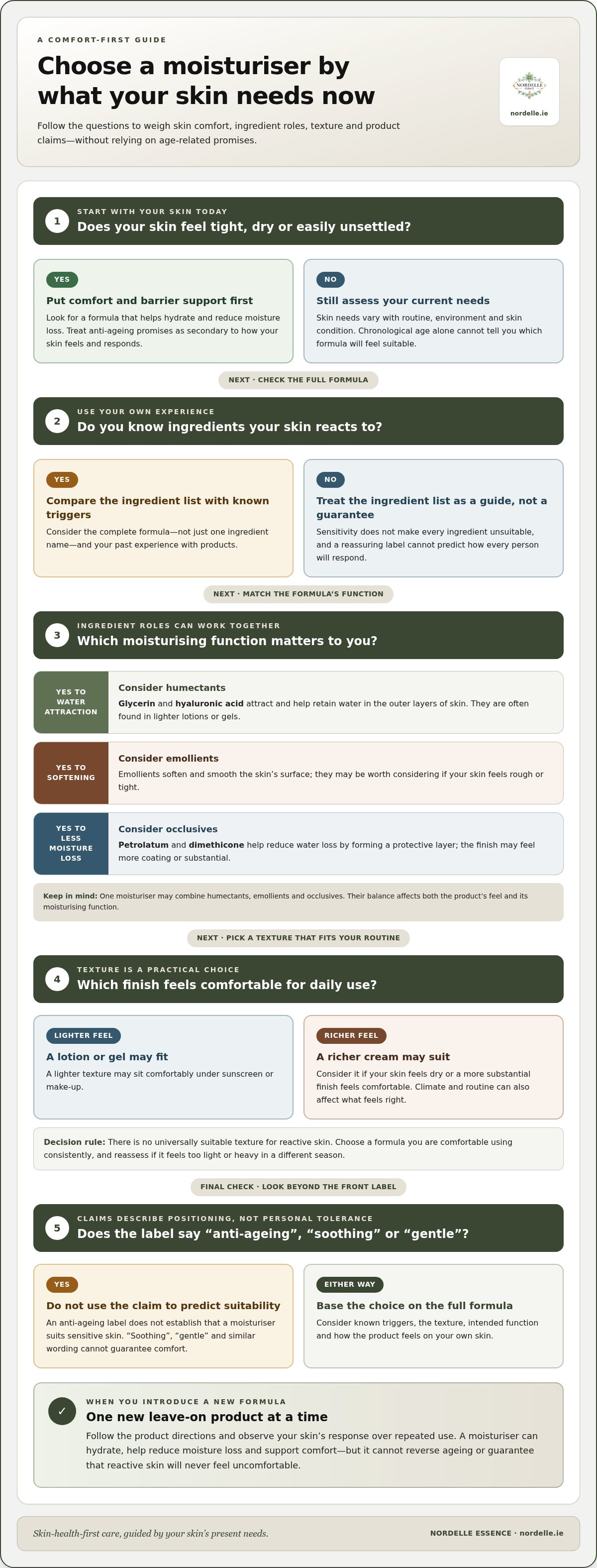
Ingredient categories help explain what a moisturiser is designed to do, but they can’t predict exactly how your skin will respond. Humectants, emollients and occlusives may work together in one formula. Their balance affects both the product’s feel and its moisturising function. Use the ingredient list as a guide, not a guarantee of comfort.
Skin can become drier or itchier with age, although experiences vary. The National Institute on Aging outlines these possible skin changes with age. If your skin is sensitive, consider both a formula’s function and how it feels on your own skin.
Humectants, emollients and occlusives: different roles in hydration
Humectants, such as glycerin and hyaluronic acid, attract and help retain water in the outer layers of skin. Emollients soften and smooth the skin’s surface, while occlusives, such as petrolatum or dimethicone, help reduce water loss by forming a protective layer. A moisturiser may combine all three categories.
| Ingredient role | Typical feel | Selection consideration |
|---|---|---|
| Humectant | Often found in light lotions or gels | Look for water-attracting ingredients such as glycerin, then consider whether the overall formula leaves your skin comfortable. |
| Emollient | Can lend a smooth, soft feel | Worth considering if skin feels rough or tight. Check the full ingredient list for known triggers. |
| Occlusive | May feel more coating or substantial | Can help limit moisture loss. Consider whether that finish suits your routine and preference. |
Choosing a texture for comfort and daily use
Texture is a practical choice, not a measure of quality. A lighter lotion or gel may sit comfortably under sunscreen or make-up, whilst a richer cream may suit skin that feels dry or benefits from a more substantial finish. Climate and routine matter too: a texture that feels pleasant in one season may feel too light or heavy in another.
There’s no universally suitable product category for reactive skin. Consider your known triggers and how a formula feels during use. An ingredient list describes what a product contains, not whether it will suit every person. For a moisturizer for sensitive ageing skin, choose a texture you’re comfortable using consistently and assess the complete formula rather than relying on one ingredient name. You can explore Nordelle Essence’s moisturiser approach when considering hydration and skin-barrier support.
How to assess moisturiser claims when your skin is sensitive
An anti-ageing label doesn’t establish that a moisturiser will suit sensitive skin. It describes the product’s positioning, not your individual tolerance. Look beyond the front of the pack to the full ingredient list, your known triggers and how the formula fits your routine.
Reading labels without relying on marketing language
Words such as “soothing”, “gentle” and “sensitive-skin friendly” can describe a product, but they need context. They don’t tell you whether a formula avoids ingredients your skin reacts to or whether it will feel comfortable in use. Read the ingredient list and compare it with your own experience. An ingredient isn’t automatically unsuitable because your skin is sensitive; equally, a reassuring claim can’t guarantee that you’ll tolerate the whole formula.
Fragrance-free may be a useful preference if you want to avoid added fragrance, particularly if you’ve noticed a personal response to fragranced products. It doesn’t promise that a moisturiser can’t cause discomfort, since reactions can have different triggers. Assess the complete formula rather than treating one label as a complete measure of suitability.
Marketing language describes how a product is presented; it doesn’t prove that the formula will suit your individual skin.
Balancing sensitivity with visible ageing concerns
Begin with comfort and tolerability. A moisturiser you can use consistently to support hydration may be a more considered starting point than adding several products in pursuit of visible changes. If a formula causes ongoing discomfort, its anti-ageing positioning is unlikely to make it a good fit for your routine.
A moisturiser doesn’t need to contain a retinoid to have a place in skincare. If you’re considering a retinol alternative moisturiser, assess it by the same principles: review the full formula, consider your known triggers and pay attention to how your skin responds. The category name alone doesn’t establish its ingredients, effects or suitability for you.
For a moisturizer for sensitive ageing skin, use this simple order of priorities:
- Comfort: Does the formula feel acceptable on your skin during use?
- Known triggers: Does the ingredient list contain anything you already choose to avoid?
- Routine fit: Can you use it comfortably alongside the other products in your routine?
- Claims: Do the product’s stated aims match what you’re looking for, without treating them as a promise of individual results?
This approach keeps visible ageing concerns in view without letting a prominent claim outweigh your skin’s response.
How to introduce and assess a new moisturiser
Introducing a product gradually gives you a clearer sense of how your skin responds. If you add several products at once, it can be difficult to identify which one may be linked to a change in comfort. Keep the rest of your routine familiar while assessing a new leave-on formula.
A measured introduction routine
Start with clean skin and follow the moisturiser’s stated directions, including how much to apply and how often to use it. Introduce one new leave-on product at a time instead of adding a moisturiser, serum and active treatment together. This makes your observations more useful without assuming that any single product will suit everyone.
A small-area test may be a helpful first step where appropriate. Apply the product as directed to a discreet area and observe how your skin feels before using it more widely. This can offer an early indication of comfort, but it can’t guarantee that a reaction won’t occur later or when the product is applied to a larger area.
As you begin regular use, notice whether the moisturiser feels comfortable during application and over repeated use. Pay attention to new stinging, itching, redness or a persistent feeling of tightness. These observations don’t establish the cause, but they can help you decide whether to pause and reassess.
When to pause and seek professional advice
If marked discomfort or a concerning reaction develops, stop using the product rather than trying to push through it. Avoid adding further new products while your skin feels unsettled, as this can make it harder to understand what is happening. Follow relevant product directions and seek advice from a qualified healthcare professional if symptoms persist, worsen or are severe.
A cosmetic moisturiser can support hydration and day-to-day skin comfort, but it isn’t a substitute for a diagnosis or prescribed treatment. Persistent skin concerns deserve individual assessment, particularly if they are changing or affecting your wellbeing.
For a moisturizer for sensitive ageing skin, build a considered routine through observation, not hurried layering. Choose a formula that fits your needs, introduce it with care and let your skin’s response guide whether it belongs in your routine. Explore moisturisers for sensitive skin as you consider your next step.
Choosing a Nordelle Essence moisturiser for sensitive ageing skin
A considered choice follows a clear order: comfort first, formula function next, then claims and fit with the rest of your routine. Start by identifying what your skin needs today. Is your priority a comfortable feel, a particular texture or a formula category that fits the way you organise your skincare? This keeps your choice grounded in experience rather than promises on a label.
Nordelle Essence is a skincare brand founded by Dr Aiste Linkeviciute-Konenko, an aesthetics doctor. Its skin-health-first philosophy prioritises hydration, skin-barrier support and healthy ageing through an evidence-based approach. This context helps explain the thinking behind the range, while your known triggers and tolerance remain central to deciding whether a formula suits you.
Matching the product category to your priority
Nordelle Essence offers a Retinol Alternative Moisturizer and a Ceramide Barrier Night Cream. Their names indicate different product categories, but a name alone doesn’t establish a formula’s full ingredients, performance or suitability for an individual.
If you are considering a retinol alternative, look beyond the product category and consider the full formulation, your skin’s current condition and your individual tolerance. Introduce one new active or treatment product at a time, particularly if your skin is prone to dryness or irritation.
A considered next step with Nordelle Essence
Healthy-looking ageing is supported by steady, tolerable care, not by choosing the most forceful claim. A moisturiser can form part of a routine centred on hydration and skin-barrier support, but it can’t reverse ageing or guarantee that irritation won’t occur. Consistency matters when a product feels suitable for your skin.
Once you’ve identified your priorities, compare them with the product category and the information provided about the formula. Nordelle Essence’s evidence-based, nature-conscious approach offers a considered perspective on skincare, without presenting a moisturiser as a substitute for individual assessment or a promise of specific results. Explore Nordelle Essence skincare as you decide what may fit your routine.
Choose comfort as your next step
A thoughtful choice starts with how your skin feels. Prioritise comfort, then consider the formula’s moisturising function, texture and place in your routine. Ingredient lists and product claims can guide comparison, but your own response matters most. Introduce a new moisturiser gradually and assess whether it remains comfortable with repeated use.
The right moisturizer for sensitive ageing skin supports hydration and everyday comfort without promising to reverse ageing or prevent every reaction. Nordelle Essence is a doctor-led skincare brand founded by an aesthetics doctor, with a skin-health-first focus on hydration, barrier support and healthy ageing. Its range includes a Retinol Alternative Moisturizer and a Ceramide Barrier Night Cream.
Once you’ve identified your priorities, explore Nordelle Essence skincare and consider which product category may fit your routine. Choose a considered, skin-health-first moisturiser from Nordelle Essence to support your hydration and barrier-care routine.
Frequently Asked Questions
What is the best moisturiser for sensitive ageing skin?
There isn’t one best formula for everyone. The best moisturizer for sensitive ageing skin is one that feels comfortable, suits your current dryness and routine, and avoids ingredients you already know don’t suit you. Consider the product’s texture and intended function, then assess the full ingredient list rather than relying on an age-related claim. Introduce a new formula cautiously and let your skin’s response guide whether it’s suitable.
Can sensitive skin use anti-ageing moisturiser?
Yes, sensitive skin can use an anti-ageing moisturiser if the individual formula feels comfortable and suits the person’s skin. The label alone doesn’t establish suitability or predict a reaction. Check the full ingredient list for known triggers and introduce the product gradually rather than adding several new formulas at once. A retinol alternative moisturiser is one product category, but its name doesn’t reveal the complete formula or guarantee that it will suit every user.
Which ingredients should I look for in a moisturiser for sensitive skin?
Consider ingredient function as well as the names on the label. Humectants such as glycerin or hyaluronic acid attract and help retain water; emollients soften the skin’s surface; occlusives such as petrolatum help reduce moisture loss. Ceramides are also commonly used in moisturisers designed to support the skin barrier. These examples can help you compare formulas, but no ingredient guarantees comfort for every person. Consider your known triggers and the complete formulation.
Is fragrance-free moisturiser better for sensitive ageing skin?
A fragrance-free moisturiser may be a useful preference if you want to avoid added fragrance or have noticed that fragranced products don’t suit your skin. It doesn’t guarantee against irritation, since discomfort can have other causes and formulas contain multiple components. Read the full ingredient list, especially if you have known triggers, and assess the product through careful use. A fragrance-free claim can inform your choice, but it can’t predict your individual response.
How do I introduce a new moisturiser to sensitive skin?
Begin with clean skin and follow the product’s directions. Introduce one new leave-on product at a time so you can observe how your skin responds without changing several parts of your routine at once. Where appropriate, try a small-area test first, remembering that it can’t guarantee there’ll be no reaction later. During repeated use, pay attention to comfort. Stop using the product if marked discomfort or a concerning reaction develops.
Can moisturiser reduce the appearance of fine lines?
Moisturiser can make fine lines look less noticeable by hydrating the skin, which may give its surface a smoother appearance. This is different from reversing the underlying changes associated with ageing, and results vary between people and products. A moisturiser’s primary role is to support hydration and reduce moisture loss, not erase lines. Choose a formula for comfort and routine fit, and keep expectations realistic about visible changes.
Should I use a different moisturiser during the day and at night?
Not necessarily. One moisturiser may suit both parts of your routine if it feels comfortable and works with your other products. Some people prefer a lighter texture during the day, particularly beneath sunscreen or make-up, and a richer cream in the evening. Choose according to feel and routine rather than assuming you need separate products. Follow each product’s directions and include sun protection as part of daytime skincare.
When should I seek professional advice about sensitive skin?
Seek advice from a qualified healthcare professional if skin symptoms are severe, persistent, worsening or causing concern. Stop using a new moisturiser if marked discomfort or a concerning reaction develops, and avoid trying to identify the cause through repeated product testing. A cosmetic moisturiser can support everyday hydration and comfort, but it can’t diagnose a skin condition or replace prescribed treatment. Professional assessment can help address symptoms that don’t settle or continue to change.